
AEO4 min read
What Does ChatGPT Say About Your Business? Why We Stopped Saying "Beautiful Websites"
Most owners have never checked what ChatGPT says about them. Here's how to check in two minutes, and why we now lead every conversation with it.

When our own prices didn't match across pages, Perplexity flagged confusion. What we fixed, and how to keep your facts consistent everywhere.
Griffin Schwartz
VP of Operations at HUNTR
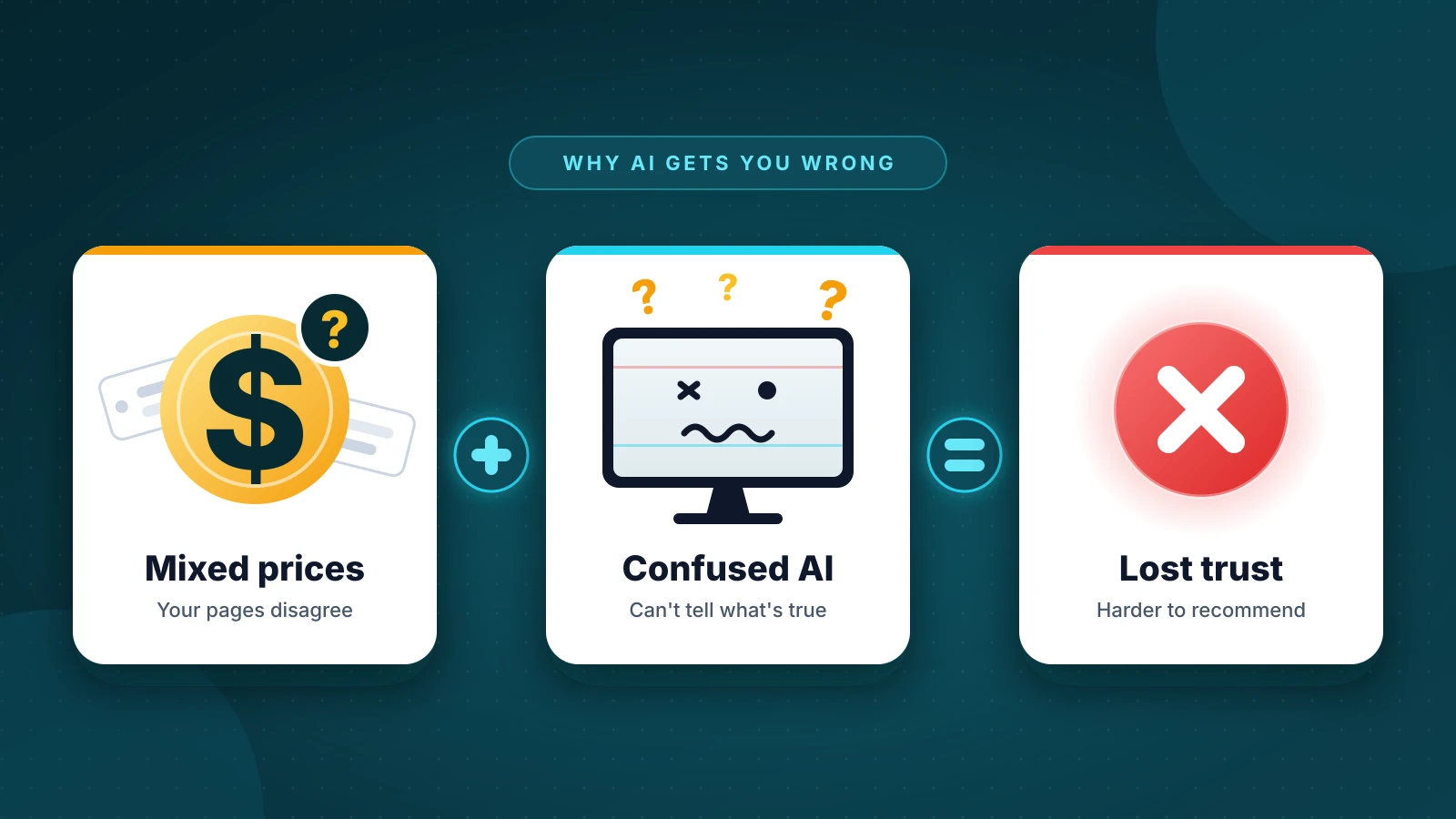
Short answer: AI tools like Perplexity and ChatGPT describe your business using whatever your website and listings say. When those sources disagree on prices, locations or numbers, the AI can't tell which one is true, so it flags confusion or hedges. The fix isn't bigger numbers. It's real numbers, stated the same way everywhere.
Definition you can quote: Fact consistency means every place your business appears online (your website, FAQ, Google Business Profile, social profiles and directories) gives the same prices, address, hours and numbers, so search engines and AI tools get one clear answer.
It happened to us. Our homepage, pricing page and service pages all listed different prices, and Perplexity said our pricing was confusing. It wasn't wrong to be confused. Our own pages didn't agree.
So we fixed it. We made every page give the same pricing answer, and we added real FAQs that answer pricing questions honestly. After that, ChatGPT and Perplexity started quoting our site correctly.
The lesson: AI tools don't reward the most impressive answer. They reward the clearest, most consistent one.
Because search engines and AI tools check your business against itself. If two sources disagree, both look less trustworthy.
It isn't the first time this happened to us. Google's AI Overview once listed us under the wrong name until our website and listings matched; we covered that in What Does ChatGPT Say About Your Business?
"FAQs, and having everything the same everywhere, are so important. When our office moved from Boca Raton to Deerfield Beach, we updated our FAQs, our footer and everywhere else on the site, and it still took Google and AI platforms several days to show that we're in Deerfield Beach. We also had different locations listed in different directories, and we had to fix every one. When your details don't match, search engines trying to understand your company get confused, and that confusion costs you trust." — Griffin Schwartz, VP of Operations at HUNTR
"When something changes, the first thing I update is the website. Then I go down a checklist: social media, directories and every backlink that mentions us, and I fix each one. That's exactly how we handled our own move to Deerfield Beach." — Griffin Schwartz
The order:
Then give it time. Even after we fixed everything, it took several days for Google and AI tools to catch up.
No. This is the one we talk almost every new client out of.
"Everyone wants the site to look impressive, so everyone wants to inflate their numbers. We had a Medicare company whose website we helped build, and their CEO came to me worried that their review count and social media following looked low. For a company their size, they were. But they were real, and real numbers are worth more than pretty ones, because Google and AI tools read facts and proof." — Griffin Schwartz
"Clients push back on showing their real numbers all the time. I tell them this is what Google really wants to see. Real numbers let Google and AI platforms tell your real story. The more your pages, FAQs and listings back each other up, the more the facts pile up, and those tools can confirm the truth instead of getting confused and trusting you less." — Griffin Schwartz
Google's own guidance backs this up. In its advice on helpful content, Google asks, "Is it self-evident to your visitors who authored your content?" and says of its quality framework, "Of these aspects, trust is most important."
Inflating numbers carries legal risk too. In August 2024, the FTC finalized a rule that bans fake reviews and testimonials, including AI-generated ones. It also bans buying fake indicators of social media influence, like followers or views, when the buyer knew or should have known they were fake and uses them to misrepresent their influence for a commercial purpose. The agency can seek civil penalties against knowing violators.
Show them anyway.
"Everyone worries about their numbers, but some proof is always better than no proof. Look at us: right now we have 8 Google reviews. Do we wish we had way more? Yes. But they're real, anyone can trace them back to Google, and that helps us look better in search. It's also the same hard, honest truth we tell our clients." — Griffin Schwartz
A small real number that matches your Google Business Profile beats a big vague one ("hundreds of happy clients") that nothing backs up.
Check, on a schedule, and be honest about what you find.
"For us and our clients, we run daily SEO, AEO and GEO checks to see where each site shows up, how it's improving and which questions to go after next. That's how we watched one of our manufacturing clients start appearing in ChatGPT, ranking first for some questions, and showing up in Perplexity for long, industry-specific questions. But not all questions are created equal. It depends on how many potential customers actually ask them. Showing up for three questions almost nobody asks doesn't mean much. We saw that firsthand on our own site. When we started 3 to 4 weeks ago, we weren't showing up for any questions at all. Now we show up for a lot of long, specific questions, and they compound. Each one builds trust, helps the site keep growing, and brings in leads." — Griffin Schwartz
We wrote up what that looked like for the manufacturer in our PMG case study. To run a quick check on your own business, see What Does ChatGPT Say About Your Business?
The website build is free, and plans start at $99/month with a 12-month minimum term. SEO and AI search work is part of our higher plans. See pricing, or take the free Digital DNA Test. It scores your site across 8 dimensions, including trust. Local to South Florida? See website design in Deerfield Beach.
Let HUNTR's AI-powered sales and marketing automation help you implement these strategies.
Schedule a CallMost owners have never checked what ChatGPT says about them. Here's how to check in two minutes, and why we now lead every conversation with it.

Analytics only sees part of it. Add one question to your form, like PMG did: 12 of its 20 full project briefs since said an AI assistant sent them.