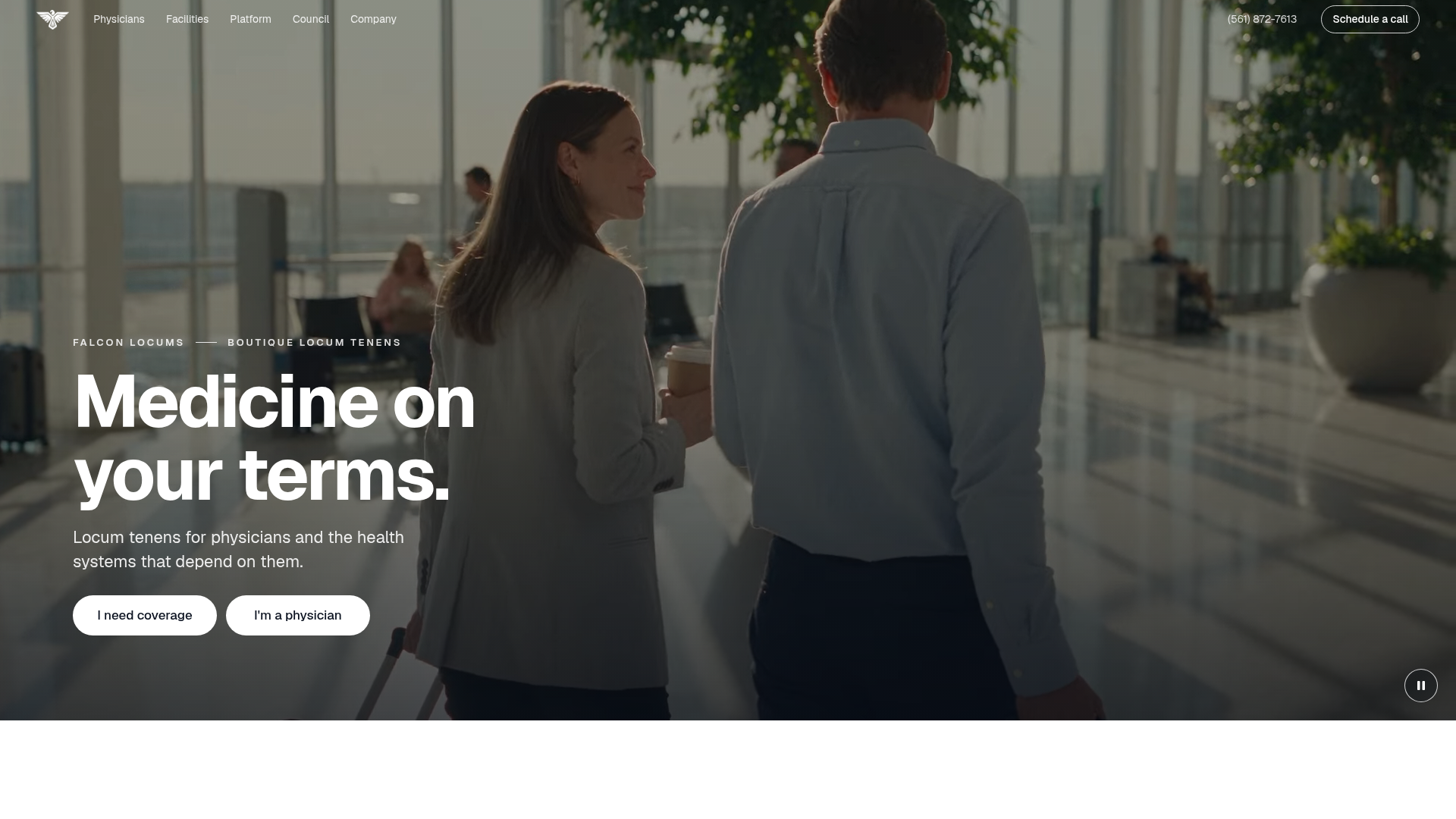
Short answer: A locum tenens staffing agency website needs two front doors: one for physicians (specialties, the credentialing process, open assignments and a named advisor) and one for facilities (speed, compliance and a single point of contact). Add a live job board, online scheduling and real team bios. That's the structure HUNTR built for Falcon Locums.
Definition you can quote: A two-audience staffing website is a site with separate paths for the people you place and the organizations that hire them, so each visitor sees the proof they care about without wading through the other side's pitch.
Why do small locum agencies struggle online?
Most boutique agencies start on relationships. Falcon Locums, a South Florida locum tenens firm founded in 2024, was "running entirely on referrals and phone outreach" with no website at all. As our Falcon Locums case study puts it, they had "no way for physicians to find open assignments, and no digital credibility when facilities went to vet them."
That gap matters more in staffing than in most industries, because both sides check you out before they call. A physician wants to know who will represent them. A hospital wants to know you can deliver credentialed coverage. If neither finds anything, the referral stalls.
What does a two-audience page map look like?
Here's the page map HUNTR built for Falcon, a pattern other small physician staffing firms can copy.
| Section |
Who it's for |
Its job |
What Falcon's site shows |
| Physician track |
Physicians |
Prove you'll advocate for their career |
Specialties, the credentialing process, the job board and the 1:1 advisor model |
| Facility track |
Hospital administrators, staffing directors |
Prove you can fill shifts fast and safely |
Speed (48-hour placement), compliance and a single point of contact |
| Job board |
Physicians |
Let them self-serve |
Open assignments to browse and apply to, by specialty and location |
| Online scheduling |
Both |
Remove back-and-forth |
A calendar booking integration for calls |
| Team and about pages, FAQ |
Both |
Build trust before the first call |
Full team profiles with photos and bios, an about page and an FAQ |
| Growth pages |
Employers, investors |
Leave room to grow |
Direct placement, temp-to-perm and an investor relations page |
What changed for Falcon Locums?
|
Before HUNTR |
After HUNTR |
| Website |
None |
Full multi-page site, "zero to live in weeks" |
| How physicians found assignments |
Referrals and phone calls |
A live job board they can browse and apply to |
| How facilities vetted the firm |
Nothing online to check |
A facility track, team bios and an FAQ to review before calling |
| Booking a first conversation |
Phone tag |
Direct calendar booking |
| Search foundation |
None |
Every page structured to rank for locum tenens terms in their target markets |
The case study doesn't publish traffic or placement numbers from the new site, so we won't either. What it does show is the result that matters first for a new firm: "Physicians can now find them, vet them, and apply, without a single phone call."
Which numbers should a staffing site lead with?
Lead with the numbers that answer each audience's main worry. Falcon's site leads with four: 48 hours average time to first placement offer, 50+ physician specialties covered, 100% credentialing managed end-to-end, and a 1:1 dedicated advisor for every physician. Facilities care about speed and credentialing; physicians care about coverage of their specialty and having someone in their corner. Put your own numbers where both can see them, and only publish numbers you can back up.
The Locum Agency Website Checklist
Print this and tick off what your site already has.
- A homepage that splits visitors into "For Physicians" and "For Facilities" in the first screen.
- A physician page listing the specialties you cover.
- A plain-English walkthrough of your credentialing process.
- A job board with open assignments filterable by specialty and location.
- An "apply" path that doesn't require a phone call.
- Your advisor model explained (who the physician talks to, and how often).
- A facility page with your speed and compliance promises.
- One named point of contact for facilities.
- Online scheduling for both audiences.
- Team profiles with real photos and bios.
- An FAQ for each audience.
- At least one real testimonial, attributed honestly (Falcon's comes from an emergency medicine physician).
What does a site like this cost with HUNTR?
HUNTR builds the website free. Plans start at $99/month for Foundation (up to 5 pages), $299/month for Visibility (up to 10 pages, plus local SEO and AI-search optimization) and $499/month for Growth Engine (up to 15 pages). Sites go live in 2 to 4 weeks. A two-audience staffing site often needs more than 5 pages, which points to Visibility or Growth Engine. See current pricing and how our websites work.
Frequently asked questions
What pages does a locum tenens agency website need? At minimum: a homepage that splits physicians and facilities, a physician page, a facility page, a job board, an about/team page, an FAQ and a contact or booking page.
Should a staffing agency website have a job board? Yes, if you place physicians. It lets them browse and apply on their own time, which is exactly what Falcon Locums lacked when it ran on referrals and phone outreach.
How long does it take to build a staffing agency website? Falcon Locums went from no website to live "in weeks." HUNTR sites typically go live in 2 to 4 weeks from the strategy call.
Can one website serve physicians and hospitals? Yes, with separate tracks. Each audience gets its own pages and proof, and shared pages (team, FAQ, scheduling) build trust with both.
Sources